
Are you looking for sessions about innovation at the ASPA 2022 national conference? I started a list. If you’re presenting a paper about innovation, then please add it. https://docs.google.com/spreadsheets/d/1v8RdUWd5QlttrXLHD9hQLKCdE5Z06P7h6CnVrtry-VQ/edit?usp=sharing
Tag: Public Administration
Independent Demonstration Projects: A Teaching Case on Government Innovation
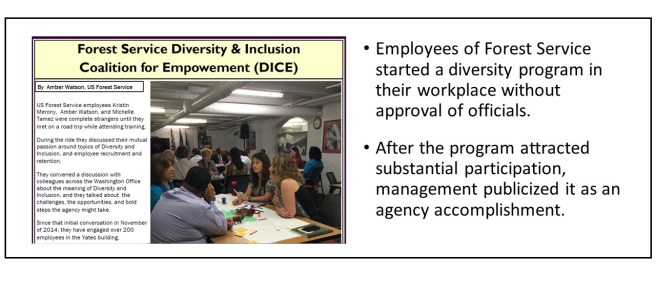
I have developed a teaching case about Independent Demonstration Projects, which is a successful strategy to implement innovations in government without prior approval of agency officials. The case is currently pending peer review for publication. I would be pleased to send a copy of the draft case materials to any faculty member who wants to examine it for possible use in their teaching. I can be reached at David.Reed@PubAdmin.org
Appointed to Editorial Board of Public Integrity

I am honored to be appointed to the Editorial Board of the journal Public Integrity. I look forward to helping to continue the high quality of that journal. https://www.tandfonline.com/action/journalInformation?show=editorialBoard&journalCode=mpin20
Newly Published Paper on Intrapreneurship Cites our Work
A new paper in the International Journal of Entrepreneurship and Innovation Management by S. Jimmy Gandhi, Colleen C. Robb and Ana Lee examines how entrepreneurial competencies can be used to encourage intrapreneurship in organizations. They cite my work on public sector workers using effectuation to implement innovations. Their new paper is at https://www.inderscience.com/info/inarticle.php?artid=115049
“Don’t Exclude Real Practitioners with the Imaginary Ones” is now Peer Reviewed and Published
The gap between academic research and practice in public administration is discussed often, but practitioners are rarely included in the discussion. My new paper in Administrative Theory & Praxis says that for the public administration research community to engage with practitioners, it should:
- Expand the concept of public administration literature to include case reports by practitioners, which have long been an important part of medical literature.
- Develop norms that reduce the risk to a practitioner’s career from sharing her innovations and experience.
- Include practitioners in gatekeeping institutions, such as conference program committees, journal editorial boards, and peer reviewers.
The paper is available for free download at https://www.tandfonline.com/eprint/7SSKBPY7ZEZA5MMRRQ6X/full?target=10.1080/10841806.2021.1910412
Independent Demonstration Projects presentation at the ASPA conference

The standard advice to government innovators is:
“First make sure you have the support of agency officials.”
That’s like advising soldiers:
“First make sure the enemy has run out of ammunition.”
It would be great, but if you wait for it to happen then you may never act.
Independent Demonstration Projects is a successful strategy to innovate in government without prior approval of officials. The innovator implements her idea as a minimum viable product, using whatever resources are available to her. Once the innovation is implemented, it creates pressure on officials to sustain or expand it using government resources.
If you’re registered for the ASPA 2021 conference, you can see our panel on-demand at https://www.engagez.net/ASPA2021?snc=707858#lct=conferencecenter–824468
It explains how the passive-aggressive sheet cake pictured here created government innovation.
My slides are open access at https://pubadmin.org/wp-content/uploads/2021/04/reed-independent-demonstration-projects-slides-for-aspa-panel.pdf
Don’t throw out the real practitioners with the imaginary ones.
The public administration research community is obsessed with serving an imaginary image of public administration practitioners, according to Professor Muhammad Azfar Nisar writing in Administrative Theory & Praxis. He suggests that researchers should stop trying to serve the imaginary practitioner, and instead engage directly with the public. I have a different suggestion; that researchers should engage with real practitioners, rather than imaginary ones. See how and why in my paper at https://osf.io/preprints/socarxiv/db7pt/
Police Performance Rankings Depend on the Functional Form of the Index
Bearfield, Maranto and Wolf (2020) advise policy-makers to measure policing outcomes using a metric that includes rates of homicide, police-related civilian deaths (PRCD) , and poverty. They present such an index, which they call the Police Performance Index (PPI). But alternative functional forms that are equally plausible can lead to different rankings of police departments, and therefore different policy conclusions. My comment presents one such alternative index, under which changes in police-related civilian deaths have a greater potential effect on a city’s ranking: https://doi.org/10.31235/osf.io/r8yst
Webinar on Promoting Ethical Conduct in Organizations
The ASPA Section on Democracy and Social Justice webinar on Promoting Ethical Conduct in Organizations is now on YouTube. It was great serving as a panelist. https://youtu.be/1U4lYwL0p5Q
Our how-to is a top 10 download on SSRN
My how-to on Public Administration Practitioners at Academic Conferences hit SSRN’s top 10 download list for PSN Educator: Public Administration. I hope it encourages more of us practitioners to engage with research. https://papers.ssrn.com/sol3/papers.cfm?abstract_id=2765800
 Center for Public Administrators